

 Free Shipping
*Applies to Ipe & Cumaru short length orders from 3–5 ft. Minimum purchase of $2,500 required. U.S. mainland only. Other conditions may apply.


What Is Accoya Wood? Uses, Sizes, Painting, Milling, and Durability
Best Sellers
Posted on November 9, 2026 at 3:43 am
Table of Content
Accoya wood is a specially modified timber designed to provide excellent durability, dimensional stability, and long-term performance in demanding exterior applications. However, one important thing to understand before buying it is that Accoya is not a natural wood species like Ipe, Cumaru, or Teak. It is a branded, acetylated wood product made from sustainably sourced softwood.
Through a specialized process called acetylation, the wood is modified to reduce moisture absorption, helping it resist swelling, shrinking, warping, and fungal decay. This makes Accoya a popular choice for applications where maintaining the shape and appearance of exterior wood is important.
For contractors, builders, architects, and homeowners, Accoya offers more than just durability. It can be machined into different profiles, used for painted exterior projects, and considered for applications such as gates, fencing, windows, doors, siding, cladding, and decking.
But before selecting Accoya for a project, there are some practical questions worth understanding:
- Can Accoya be painted?
- Can it be milled into tongue-and-groove profiles?
- Is it available in 2×6 and 2×8 dimensions?
- Can it be used for gates and fences?
- What is the difference between Accoya Natural and Accoya Color?
- How long does the manufacturer warranty last?
This guide explains how Accoya works, where it performs best, what sizes and profiles to consider, and what to check before ordering.
What Is Accoya Wood?
Accoya is a branded form of acetylated wood manufactured by modifying sustainably sourced timber through a controlled chemical process.
The important distinction is that Accoya is not another hardwood species. It starts as softwood, primarily radiata pine, and undergoes acetylation to improve its performance.
This modification changes how the wood interacts with moisture. Ordinary wood naturally absorbs and releases moisture from its surroundings. This can cause dimensional changes over time.
Accoya is designed to reduce that movement.
It retains the natural characteristics of timber and can be cut, drilled, routed, shaped, and finished using conventional woodworking equipment.
For contractors and manufacturers, this means Accoya can be considered for projects that require real wood but need better stability and durability than many untreated softwood products provide.
How Is Accoya Wood Made?
Accoya is manufactured using a process called acetylation.
Wood naturally contains hydroxyl groups that attract and hold moisture. When the moisture content changes, the wood can expand or contract.
During acetylation, the timber is treated with acetic anhydride. This introduces acetyl groups into the wood’s cell structure, reducing its ability to absorb moisture.
Unlike a surface coating or preservative treatment, acetylation modifies the wood throughout the treated material.
This is important when the timber is cut, drilled, routed, or machined because the modification is not limited to the outer surface.
The practical results include:
- Reduced moisture absorption
- Improved dimensional stability
- Better resistance to fungal decay
- Reduced swelling and shrinking
- Improved performance in exterior applications
For a contractor, the most important benefit is that Accoya is designed to maintain its shape more consistently when exposed to changing outdoor conditions.
What Makes Accoya Different From Regular Wood?
Regular wood responds to moisture changes. Depending on the species, cut, grain, and environmental conditions, it may swell, shrink, cup, twist, or warp.
These changes can create problems in finished exterior products.
For example, a wooden gate that swells or twists can become difficult to open and close. Fence boards that move excessively can affect the spacing and appearance of a fence panel. Exterior doors and windows can also experience fitting and operating problems when their components move.
Accoya’s reduced moisture uptake helps minimize these issues.
Its stability is particularly valuable when timber is used in products that need consistent dimensions, accurate joints, and a reliable finish.
What Do Contractors Actually Use Accoya For?
Accoya is used in several architectural and exterior applications. While decking, siding, windows, and doors are common examples, gates and fencing are also important applications.
1. Gates
Accoya is worth considering for exterior gates where stability, appearance, and paintability are important.
A gate is exposed to sunlight, rain, humidity, and changing temperatures. If its timber components swell, shrink, or twist excessively, the movement can affect alignment, gaps, hinges, and the way the gate operates.
Accoya’s dimensional stability helps reduce moisture-related movement, making it a practical material to consider for:
- Driveway gates
- Garden gates
- Pedestrian gates
- Side entrance gates
- Custom architectural gates
- Painted exterior gates
It can also be machined to create different profiles and design details.
For larger gate projects, contractors should specify the required thickness, finished dimensions, joinery, machining, and paint system before ordering.
2. Fencing
Accoya can also be considered for residential and commercial fencing.
Fence panels remain exposed to outdoor conditions throughout the year. Changes in moisture can affect the shape and spacing of individual boards.
Because Accoya moves less than many conventional untreated woods, it can help maintain a more consistent appearance.
Common applications include:
- Privacy fencing
- Garden fencing
- Decorative fence panels
- Architectural screening
- Painted exterior fencing
- Custom fence sections
For projects involving multiple gates and numerous fence sections, consistent material dimensions and finishing requirements are especially important.
Contractors should also consider post construction, ground clearance, drainage, and the correct installation details when designing the complete fence system.
3. Decking

Accoya is used for residential and commercial decking where dimensional stability and durability are important.
Its reduced movement can help deck boards remain flatter and maintain more consistent gaps.
The manufacturer’s decking literature also highlights several practical benefits:
- Smaller gaps between decking boards
- A more even surface
- Cooler underfoot performance in hot weather compared with traditional wood decking species
- A smooth surface that is less prone to splintering
These characteristics make Accoya worth considering for patios, pool surrounds, and other barefoot areas.
However, regular cleaning and correct installation remain important. No natural wood decking should be described as completely maintenance-free or guaranteed never to splinter.
4. Siding and Cladding
Accoya is also used for exterior siding and architectural cladding.
Dimensional stability can help reduce excessive movement across large exterior surfaces.
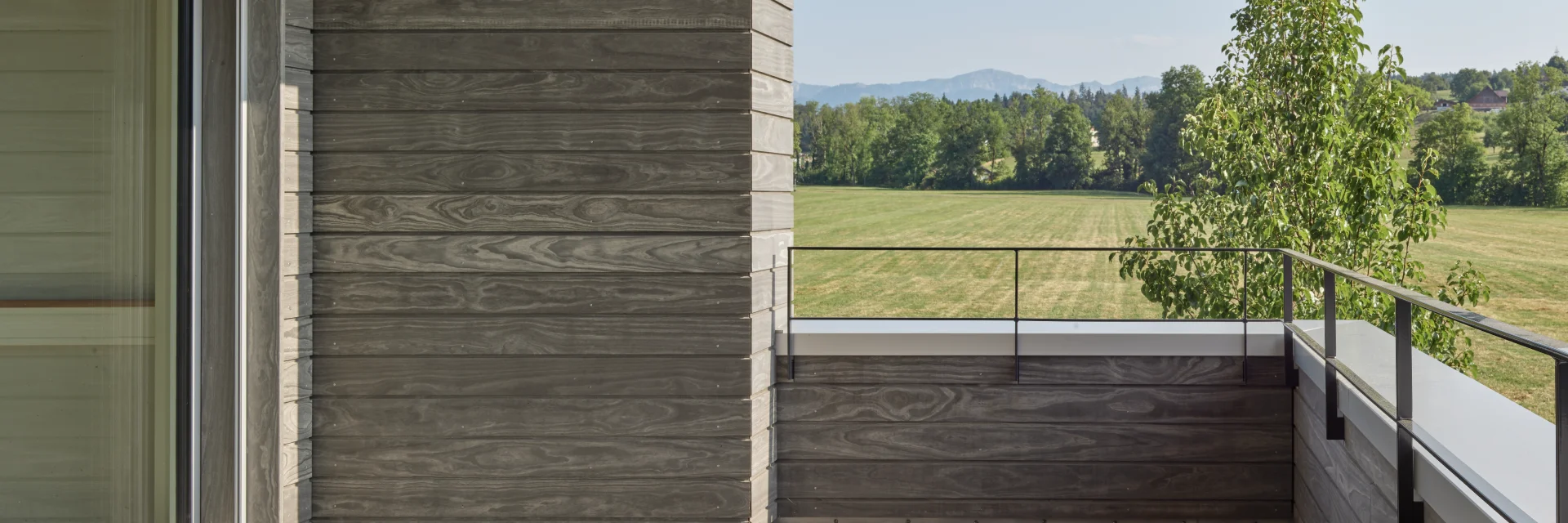
It can be painted, stained, textured, or left uncoated to weather naturally, depending on the desired architectural appearance.
5. Windows and Doors
Windows and doors require accurate dimensions and properly fitting components.
Excessive swelling or shrinking can affect how these products operate.
Accoya’s stability makes it suitable for manufacturing exterior window and door components, including painted joinery.
6. Pergolas and Outdoor Structures
Accoya can be used for pergolas, garden structures, screens, outdoor furniture, and architectural features.
The appropriate dimensions, structural design, fixing methods, and exposure conditions should be evaluated for each project.
Can Accoya Be Milled Into Tongue-and-Groove Profiles?
Yes. Accoya can be machined into custom profiles, including tongue-and-groove (T&G).
Tongue-and-groove is a common profile used when boards need to fit together along their edges. One side has a projecting tongue, while the opposite side has a matching groove.
This creates a connected surface and is commonly used for:
- Exterior siding
- Interior wall paneling
- Ceiling boards
- Soffits
- Decorative wood panels
- Custom architectural applications
Accoya can be processed using conventional woodworking equipment, making custom profiling possible.
However, custom milling depends on the starting stock, required finished dimensions, profile design, and available machining capabilities.
It is important to distinguish between purchasing standard finished lumber and ordering material that needs additional machining.
If your project requires T&G, provide the supplier with the required board width, thickness, profile drawing, quantity, and length before requesting a quote.
Custom milling may add production time, particularly when the required dimensions or profiles are not readily available.
S4S vs. Custom-Milled Accoya: What Is the Difference?
When purchasing Accoya, contractors should understand the difference between standard surfaced lumber and custom-milled profiles.
What Is S4S Accoya?
S4S stands for Surfaced Four Sides.
It means the board has been machined on all four sides to provide smooth, finished surfaces.
S4S lumber is commonly used when contractors want material that is ready for further fabrication, cutting, assembly, or finishing.
It can be suitable for applications such as gates, fence components, trim, and other woodworking projects.
What Is Custom-Milled Accoya?
Custom-milled Accoya is material that has been machined into a particular shape or profile to meet project requirements.
Examples include:
- Tongue-and-groove
- Beveled edges
- Rounded edges
- Decorative profiles
- Custom siding profiles
- Special architectural shapes
The required profile should be confirmed before production.
A board supplied as S4S is not automatically a tongue-and-groove board. Additional machining is needed to create that profile.
What Sizes Does Accoya Come In?
Accoya is supplied in different dimensions, grades, and forms depending on the market and distributor.
For contractors, it is useful to understand the difference between nominal lumber dimensions and actual finished dimensions.
Common American lumber terminology includes:
| Nominal size | General description |
|---|---|
| 1x material | Thinner boards used for siding, trim, and smaller components |
| 2x material | Thicker lumber used for heavier components and fabrication |
| 2×6 | Commonly requested for substantial boards and exterior construction |
| 2×8 | Used where wider and thicker stock is required |
These are familiar lumber size designations, not a guarantee that every size is available in Accoya at all times.
Is Accoya Available in 2×6 and 2×8?
Availability of thicker 2x material should be confirmed with the supplier.
A contractor looking for 2×6 or 2×8 Accoya should confirm:
- Whether the requested nominal size is available
- Whether the material is rough-sawn or surfaced
- Whether S4S machining is available
- The actual finished thickness and width
- Available board lengths
- Grade and quality requirements
- Whether additional milling is required
This is particularly important when a project has already been designed around specific dimensions.
Do not assume that a nominal 2×6 or 2×8 will have the same finished dimensions as its nominal designation.
Does Accoya Come in S4S?
Accoya can be machined into surfaced lumber, including S4S, depending on the starting stock and supplier’s processing capabilities.
However, stock availability and finished-product availability are not necessarily the same.
If you need S4S material in a thicker dimension, confirm that requirement when requesting a quote rather than assuming it is part of the standard stock offering.
Is Accoya Good for Painted Exterior Projects?
Yes. Paintability is one of the important advantages of Accoya, particularly for exterior architectural applications.
It is commonly considered for painted:
- Gates
- Fences
- Windows
- Doors
- Siding
- Cladding
- Exterior trim
- Architectural features
The reason is its dimensional stability.
When conventional wood repeatedly swells and shrinks, the movement places stress on the coating applied to its surface. Over time, this can contribute to cracking, peeling, and additional maintenance.
Accoya’s reduced movement provides a more stable surface for coatings.
According to the manufacturer, its improved dimensional stability and reduced swelling and shrinking can allow coating maintenance intervals to increase by up to twice the normal life of coatings applied to non-modified woods. Actual results depend on the coating system, application, exposure, and maintenance.
What Should You Know Before Painting Accoya?
Although Accoya is suitable for painted exterior applications, the correct coating system and preparation are important.
The manufacturer’s coating guidance recommends:
- Applying coatings to dry, clean, dust-free timber.
- Following the coating manufacturer’s preparation and application instructions.
- Using an appropriate primer for opaque paint systems.
- Properly sealing end grain with a compatible product.
- Allowing coatings to cure under the recommended conditions.
- Using suitable corrosion-resistant hardware.
- Avoiding opaque coatings containing calcium carbonate fillers because they can cause blistering.
Factory-applied coatings are strongly recommended where practical. If finishing on site, the coating system’s application sequence and requirements should be followed.
Most importantly, do not assume that every exterior paint is automatically suitable for every Accoya application.
The coating manufacturer should confirm compatibility and the correct preparation, primer, application, and curing requirements. For a specialized paint-grade gate or fence project, it is sensible to confirm the exact finishing specification with the Accoya technical representative as well.
Accoya Natural vs. Accoya Color: What Is the Difference?
Accoya Natural and Accoya Color are two different appearance options.
Understanding the difference is important when choosing material for decking, fencing, cladding, or other architectural applications.
Accoya Natural
Accoya Natural has a light, natural timber appearance.
When left uncoated outdoors, it gradually weathers and develops a silver-gray appearance.
This weathering happens over time because of exposure to sunlight and outdoor conditions.
The final appearance may vary depending on UV exposure, shading, ventilation, surface texture, and installation details.
Natural weathering does not mean that the wood has been manufactured with gray color throughout its structure.
Accoya Color
Accoya Color Grey is a specially manufactured version of Accoya with gray coloration throughout the wood.
The color extends from the surface to the core rather than being applied only as a surface coating.
This is an important difference.
If a board is cut or experiences normal surface wear, the gray color is still present within the material.
Accoya Color is particularly relevant for projects where a gray timber appearance is wanted from the beginning without waiting for natural weathering.
It is used for applications such as:
- Decking
- Exterior architectural features
- Outdoor living areas
- Selected cladding applications
- Contemporary landscape projects
The gray color can vary naturally between boards, so customers should review samples and confirm the available product and grade before ordering.
The key difference: Accoya Natural starts with a natural timber appearance and can gradually turn silver-gray outdoors. Accoya Color is manufactured with gray color throughout the wood.
If you are considering Accoya Color for a project, confirm its current availability and product-specific warranty with your supplier.
How Long Does Accoya Last? Understanding the Manufacturer Warranty
One of the strongest advantages of Accoya is its manufacturer’s warranty.
For Accoya wood covered by the U.S. and Canada warranty, the manufacturer provides:
| Application | Warranty period |
|---|---|
| Above-ground use | 50 years |
| At or below ground level | 25 years |
These warranty periods are subject to the official warranty terms and conditions.
The warranty covers specified material damage from fungal decay or rot and excessive swelling or shrinkage that affects the wood’s intended function. It should not be interpreted as a guarantee against every possible type of damage, installation issue, or surface defect.
Why Ground Clearance Matters
There is an important detail in the U.S. and Canada warranty that contractors should understand.
If the finished product does not comply with established norms for water drainage or water evaporation, or if it is positioned less than 8 inches above ground, it is treated as Use Class 4.
In these circumstances, the 25-year warranty applies instead of the 50-year above-ground warranty.
This makes ground clearance and drainage important design considerations when using Accoya for fencing, gates, landscaping, and other exterior projects.
Does Installation Affect the Accoya Warranty?
Yes.
The manufacturer requires Accoya to be stored, installed, and used according to its written instructions, applicable certification requirements, and relevant building codes.
Failure to follow the manufacturer’s installation instructions can invalidate the warranty.
Contractors should pay particular attention to:
- Proper storage before installation
- Adequate ventilation
- Water drainage and evaporation
- Ground clearance
- Suitable fixings and hardware
- Correct construction and installation details
- Application-specific manufacturer instructions
The warranty document also includes exclusions and claim procedures. Buyers should review the complete current warranty rather than relying only on the headline warranty period.
You can review the official Accoya U.S. and Canada warranty.
Is Accoya Resistant to Termites and Insects?
Accoya has strong resistance to biological deterioration, including fungal decay and certain wood-destroying insects.
The acetylation process changes the wood’s structure, making it less susceptible to biological attack.
The manufacturer identifies resistance to decay and termites among Accoya’s performance benefits.
However, it is more accurate to describe Accoya as insect-resistant rather than termite-proof.
No broad statement should replace consideration of the local insect environment, application, installation conditions, and relevant warranty terms.
Is Accoya Wood Waterproof?
No. Accoya should not be described as completely waterproof.
It is still a natural wood product, but acetylation significantly reduces its ability to absorb moisture.
This helps reduce the swelling and shrinking that commonly occur in untreated timber.
However, proper drainage, ventilation, and installation remain important. Water should not be allowed to collect or remain trapped around the finished product.
Does Accoya Wood Rot?
Accoya has excellent resistance to fungal decay because of its acetylation process.
This is one reason it is used for exterior applications where conventional untreated softwood may deteriorate more quickly.
However, its durability does not mean that poor installation or unsuitable exposure conditions can be ignored.
Drainage, ventilation, ground clearance, and correct detailing still matter.
Does Accoya Need Maintenance?

Accoya generally requires less maintenance than many conventional exterior timber products, but the maintenance requirements depend on the finish and application.
There is a difference between maintaining the wood’s performance and maintaining its appearance.
For example:
- Uncoated Accoya can weather naturally and develop a silver-gray appearance.
- Painted Accoya needs periodic coating inspections and maintenance.
- Stained Accoya may need refinishing depending on the stain and exposure.
- Accoya Color decking should be cleaned regularly according to the manufacturer’s maintenance guidance.
The underlying durability of Accoya does not depend on a surface coating. Finishes are primarily selected for appearance and additional surface protection where appropriate.
Accoya vs. Traditional Softwood
The main difference between Accoya and untreated softwood is how they respond to moisture and outdoor exposure.
| Feature | Accoya | Untreated Softwood |
|---|---|---|
| Material | Acetylated softwood | Natural softwood |
| Moisture absorption | Significantly reduced | Generally higher |
| Dimensional stability | Excellent | Species-dependent |
| Resistance to fungal decay | Excellent | Varies by species |
| Painting | Suitable with compatible systems | Suitable with compatible systems |
| Custom machining | Yes | Yes |
| Exterior applications | Excellent for suitable designs | Application-dependent |
| Initial cost | Generally higher | Generally lower |
Untreated softwood can still perform well in outdoor applications when properly selected, designed, installed, and maintained.
Accoya offers a different performance profile for projects where stability and durability are priorities.
Accoya vs. Hardwood: Which Should You Choose?
Accoya and traditional hardwoods serve different purposes, so the right choice depends on the project.
Naturally durable hardwoods such as Ipe, Cumaru, and Teak are known for their density, strength, natural durability, and distinctive appearance.
Accoya is a modified softwood designed to provide excellent dimensional stability and resistance to decay.
Consider the following:
| Application | Material considerations |
|---|---|
| Painted exterior gates | Accoya’s stability and coating performance are useful |
| Painted fencing | Accoya is worth considering for dimensional stability |
| High-traffic decking | Compare hardness, wear resistance, and surface requirements |
| Architectural cladding | Accoya offers stability and finishing flexibility |
| Exterior windows and doors | Accoya’s dimensional stability is valuable |
| Natural hardwood decking | Ipe and Cumaru offer high density and natural hardwood appearance |
For example, a contractor building painted driveway gates may prioritize dimensional stability and coating performance. A contractor installing a high-traffic hardwood deck may prioritize surface hardness and abrasion resistance.
There is no single best material for every application.
Advantages of Accoya Wood
1. Excellent Dimensional Stability
Accoya absorbs less moisture than untreated wood, helping reduce swelling, shrinking, warping, and twisting.
2. High Durability
It offers excellent resistance to fungal decay and is designed for demanding exterior applications.
3. Suitable for Painted Projects
Its stability can reduce stress on coatings and help extend maintenance intervals.
4. Custom Machining
Accoya can be processed into different shapes and profiles, including tongue-and-groove, depending on the stock and machining requirements.
5. Suitable for Gates and Fencing
Its reduced movement makes it worth considering for applications where maintaining fit and alignment is important.
6. Long Manufacturer Warranty
The U.S. and Canada warranty provides 50 years above ground and 25 years at or below ground, subject to the official conditions.
7. Natural Wood Appearance
Accoya retains the appearance and working characteristics of real timber.
Disadvantages of Accoya Wood
Accoya is not the right choice for every project.
Higher Initial Cost
Accoya generally costs more than standard untreated softwood.
However, its longer service life and reduced maintenance requirements may provide value over time.
Not as Hard as Dense Tropical Hardwoods
Accoya is made from modified softwood. It does not offer the same density and surface characteristics as hardwoods such as Ipe.
For some high-traffic decking applications, a dense hardwood may be a better choice.
Availability Can Vary
Not every thickness, length, or profile is necessarily available as standard stock.
Thicker 2x material, special lengths, and custom-milled T&G profiles may require additional production or sourcing time.
Custom Milling May Add Lead Time
If a project requires special dimensions, S4S surfacing, or custom profiles, machining requirements should be finalized before ordering.
Coatings Still Need Correct Application
Accoya has excellent coating performance, but paint systems must still be selected, prepared, and applied correctly. Painted surfaces also need maintenance to preserve their appearance.
Before Ordering Accoya: A Contractor’s Checklist
Before requesting a quote, it helps to have the project specifications ready.
This reduces confusion about stock availability, machining, finished dimensions, and delivery timelines.
Use this checklist when discussing an Accoya order with your supplier:
- Application: Gates, fencing, decking, siding, cladding, windows, or another project.
- Nominal dimensions: Specify whether you need 1x or 2x material.
- Finished dimensions: Confirm the actual thickness and width after machining.
- Profile: S4S, rough-sawn, tongue-and-groove, or another custom profile.
- Lengths: Specify the required board lengths.
- Quantity: Provide the total number of boards or linear footage.
- Appearance: Accoya Natural or Accoya Color, if available.
- Finish: Painted, stained, or left natural.
- Exposure: Above-ground, near-ground, or other installation conditions.
- Ground clearance: Confirm the design complies with applicable warranty requirements.
- Machining: Identify whether additional milling is required.
- Lead time: Confirm stock availability and estimated production time.
For a project involving multiple gates and fence sections, these details are particularly important. Having the dimensions, profile, quantity, and finishing requirements ready makes it easier to evaluate the material and obtain an accurate quote.
Is Accoya Worth It?
Accoya can be a worthwhile investment when a project requires long-term exterior performance, dimensional stability, and a natural wood appearance.
It is particularly attractive for painted gates, fencing, windows, doors, cladding, and architectural projects where excessive movement can cause fitting or maintenance problems.
For decking, the decision should also consider surface hardness, foot traffic, appearance, and the intended use of the space.
Although the initial cost may be higher than standard softwood, the combination of durability, coating performance, and dimensional stability can make Accoya a practical long-term choice.
The best way to decide is to compare materials based on the actual application rather than price alone.
FAQs About Accoya Wood
1. Is Accoya a hardwood or softwood?
Accoya is not a natural wood species. It is a branded, acetylated wood product generally manufactured from radiata pine, which is a softwood. The acetylation process improves its durability and dimensional stability.
2. Can Accoya be used for gates and fences?
Yes. Accoya can be considered for driveway gates, garden gates, privacy fencing, and decorative fence panels. Its dimensional stability helps reduce swelling, shrinking, and twisting that can affect alignment and appearance.
3. Can Accoya be painted?
Yes. Accoya is suitable for painted exterior applications, including gates, fences, windows, doors, and siding. Its dimensional stability helps reduce stress on coatings. The correct primer, paint system, preparation, and application instructions should be confirmed with the coating manufacturer.
4. Can Accoya be milled into tongue-and-groove?
Yes. Accoya can be custom-milled into tongue-and-groove profiles, depending on the starting stock and machining requirements. Custom profiling may require additional production time.
5. Is Accoya available in 2×6 and 2×8?
Availability depends on current stock and supply. Contractors should confirm the specific dimensions, lengths, grade, and whether S4S machining is available before placing an order.
6. What does S4S mean in Accoya lumber?
S4S means Surfaced Four Sides. It describes lumber that has been machined on all four sides to create smooth finished surfaces. It is different from a custom-milled profile such as tongue-and-groove.
7. What is the difference between Accoya Natural and Accoya Color?
Accoya Natural has a light timber appearance and can gradually weather to silver-gray outdoors. Accoya Color Grey is manufactured with gray coloration throughout the wood, from the surface to the core.
8. How long is the Accoya warranty?
Under the manufacturer’s U.S. and Canada warranty, Accoya has a 50-year warranty for qualifying above-ground applications and a 25-year warranty for qualifying applications at or below ground level. All warranty conditions and exclusions apply.
9. Does Accoya need to be installed 8 inches above ground?
The U.S. and Canada warranty states that if an end product is positioned less than 8 inches above ground, or does not meet established water drainage or evaporation norms, it is treated as Use Class 4 and the 25-year warranty applies. The project should be designed according to the official installation and warranty requirements.
10. Is Accoya termite-proof?
Accoya is resistant to termites and other biological deterioration, but it should not be described as completely termite-proof. Actual performance and warranty coverage depend on the application and applicable conditions.
11. Is Accoya suitable for decking around swimming pools?
Accoya can be used for poolside decking. Its stability, smooth surface, cooler underfoot performance, and reduced tendency to splinter make it an option worth considering for barefoot areas. Proper installation and regular cleaning are still important.
12. Does Accoya turn gray naturally?
Yes. Uncoated Accoya Natural can gradually develop a silver-gray appearance through outdoor weathering. This is different from Accoya Color Grey, which is manufactured with gray color throughout the wood.
13. Does custom milling increase the cost and lead time?
It can. Additional machining, special dimensions, and non-standard profiles may involve extra processing and production time. Confirm the requirements and estimated lead time with your supplier before ordering.
14. Is Accoya waterproof?
No. Accoya is not completely waterproof. Its acetylation process significantly reduces moisture absorption, but correct drainage, ventilation, and installation are still essential.
15. Can Accoya be used for commercial projects?
Yes. Accoya can be considered for residential, commercial, and architectural projects, including gates, fencing, decking, cladding, windows, and doors. The appropriate grade, dimensions, design, and installation requirements should be evaluated for each project.
Conclusion
Accoya is more than just another type of lumber. It is a modified wood product designed to provide excellent durability, dimensional stability, and long-term performance in exterior applications.
For contractors and builders, its value goes beyond resistance to moisture and decay. It can be considered for painted gates, fence sections, windows, doors, siding, cladding, decking, and custom architectural projects. Its ability to be machined into different profiles, including tongue-and-groove, also provides flexibility when working with specific project designs.
Before ordering, it is important to confirm the required dimensions, whether you need S4S or custom milling, available 1x or 2x stock, finishing requirements, quantities, and lead times. For exterior installations, ground clearance and drainage should also be considered because they can affect the applicable manufacturer warranty.
At Brazilian Lumber, we help contractors, builders, architects, and homeowners source quality lumber for residential and commercial projects. Whether you are considering Accoya for gates, fencing, decking, siding, or another exterior application, our team can help you discuss material requirements, dimensions, and available options.
Contact Brazilian Lumber to discuss your Accoya project, confirm current availability, and request a quote. We offer national shipping across the United States.
We can mill customs sizes
Premium decking